
 English
 Tiếng Việt

[NEWS] CHILI GROWING PARTNERSHIP HELPS FARMERS STABILIZE OUTPUT
08 Jul 2026
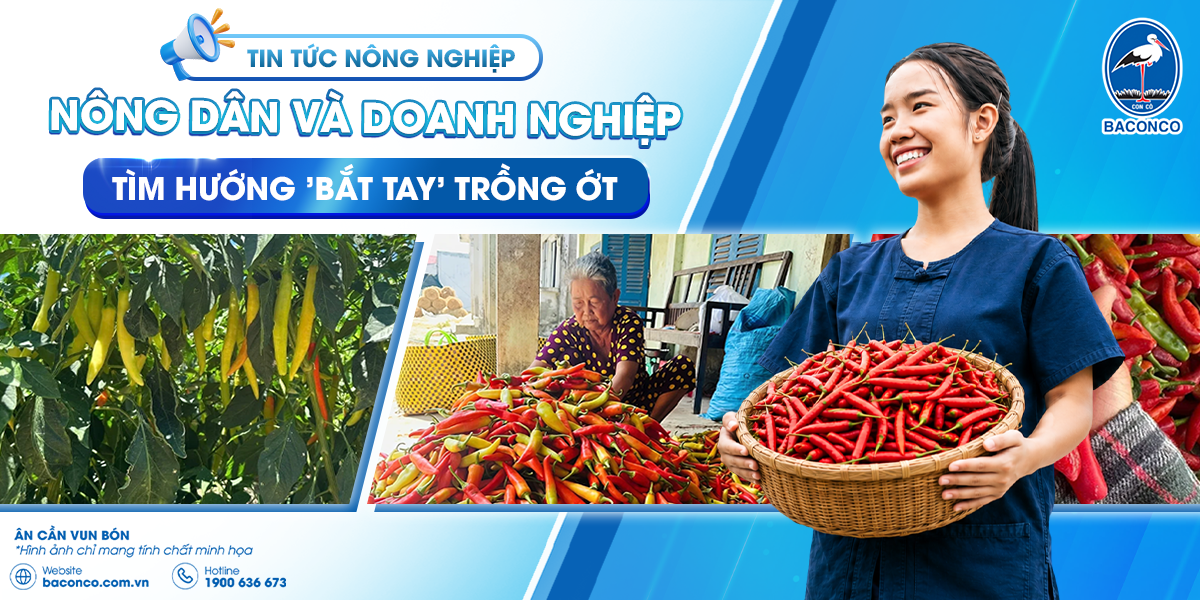
Many farmers in Can Tho are under pressure as chili prices fall in some areas, while chili growing partnership is seen as a solution to improve production efficiency.
Chili growing partnership opens a new direction for farmers
Chili growing partnership is gaining attention from many farmers and cooperatives amid strong fluctuations in chili market prices. In Can Tho City, many farmers growing chili are under pressure as the price of buffalo horn chili in some localities has dropped to around VND 4,000 - 6,000 per kilogram.
At this price level, many chili-growing households face difficulties in balancing production costs and seasonal profits. Instead of depending entirely on traders, many farmers are beginning to seek a chili growing partnership with enterprises to stabilize agricultural product output, build a chili raw material area and follow clearer production standards.
This story shows that the agricultural market is gradually changing. Farmers are no longer producing only based on experience, but need to gradually participate in value chains to improve output stability and enhance the value of agricultural products.
Farmers growing chili seek a more stable output direction
In Vinh Chau Ward, Samaki Organic Agricultural Cooperative currently has about 30 households of farmers growing chili, while also linking with additional households outside the cooperative to form a chili raw material area of around 50 - 60 hectares.
According to local records, buffalo horn chili is suitable for the hot weather conditions of the sandy land in Vinh Chau. With well-drained, airy soil conditions and manageable pest pressure, chili yield can reach around 2.5 - 3 tons per cong.
However, when agricultural product output depends heavily on traders, purchase prices often fluctuate significantly. This makes farmers growing chili more vulnerable to the situation of good harvests but low prices, making it difficult to plan production for the following crops.
Therefore, chili growing partnership with processing enterprises is considered a direction that gives farmers more opportunities to stabilize output and reduce risks from market price fluctuations.
Building an organized chili raw material area
One notable point of the chili growing partnership model is the development of an organized chili raw material area. Instead of each household planting, harvesting and selling separately at different times, farmers participating in the partnership need to have a clearer production plan.
The formation of a chili raw material area helps enterprises understand the list of participating households, planting schedules, expected output and harvest timing. Thanks to this, enterprises can proactively plan purchasing, processing and payment.
On the other hand, farmers also have a basis for producing according to market orientation and limiting spontaneous cultivation. When the chili raw material area is well organized, product quality is easier to control and the consumption process becomes more stable.
This is an important factor so that agricultural product output no longer depends only on trader prices at each point in time, but gradually connects with the actual demand of processing enterprises.
Processing enterprises create more consumption opportunities for agricultural products
Buffalo horn chili has bright red color, mild spiciness, a slightly pungent taste and thick flesh, making it suitable for chili sauce processing. This is why processing enterprises are interested in building a stable raw material area for production.
The cooperative is currently developing a plan to connect with processing enterprises in Soc Trang, where a chili sauce processing factory is being invested with a demand of around 2,000 tons of raw materials per year.
When processing enterprises participate in the value chain, farmers no longer simply grow crops and wait for purchasing as before. They also need to meet requirements for output, quality and delivery timing. This helps agricultural products have more opportunities to participate more deeply in the value chain.
With a full-package purchasing model, the lowest price of around VND 12,000 - 13,000 per kilogram depending on market conditions is considered a positive signal for farmers growing chili. This creates a basis for farmers to calculate costs, profits and production plans more effectively.
Standardized production helps enhance agricultural value
Standardized production is an important requirement when farmers participate in a chili growing partnership with enterprises. In this model, products not only need to meet output requirements, but also need to meet standards for preliminary processing, classification and raw material quality.
Farmers need to become familiar with planning planting schedules, estimating output, identifying harvest time, preliminary processing, classifying, removing stems and cleaning products according to requirements. This is a major shift compared with spontaneous production practices in the past.
Standardized production helps farmers improve professionalism in cultivation, while also helping processing enterprises have a more stable supply of raw materials. When product quality is more consistent, consumption potential and agricultural product value can also be improved.
For farmers, this story shows that standardized production is not only a requirement from enterprises, but also a necessary direction to improve the stability of agricultural product output amid market fluctuations.
Chili growing partnership should begin with a new production mindset
The approach in Vinh Chau shows a clear change in farmers’ production mindset. From individual, experience-based production, farmers are gradually shifting toward cooperation, product standardization and more active participation in the value chain.
Chili growing partnership is not only a matter between farmers and enterprises, but also requires coordination among cooperatives, local authorities and purchasing units. When all parties agree on cultivated area, crop timing, output and product standards, the value chain can operate more effectively.
For farmers growing chili, participating in a value chain helps reduce output risks and improves access to the processing market. For processing enterprises, a stable raw material area allows them to be more proactive in production, purchasing and processing plans.
From this reality, chili growing partnership can be seen as a noteworthy direction, especially in the context of fluctuating agricultural prices and increasingly clear processing demand.
Conclusion
Chili growing partnership is one of the directions that helps farmers stabilize agricultural product output, build an organized chili raw material area and gradually follow standardized production. When farmers, cooperatives and processing enterprises join the value chain together, agricultural product value has more opportunities to be improved in a more sustainable way.
Source: https://nongnghiepmoitruong.vn/nong-dan-va-doanh-nghiep-tim-huong-bat-tay-trong-ot-d810844.html
Views
3