
 English
 Tiếng Việt

HEALTHY RATOON CANE – FERTILIZATION TECHNIQUES FOR RATOON SUGARCANE TO PROMOTE THICK STALKS AND LONG INTERNODES
22 Jul 2026

Fertilization techniques for ratoon sugarcane applied at the right growth stages help stimulate strong shoot regeneration, promote thick stalks, long internodes, improve sugar accumulation, and support sustainable sugarcane production.
Fertilization techniques for ratoon sugarcane help ensure vigorous regrowth and uniform development
After harvest, sugarcane enters the ratoon regeneration stage, a critical period that determines the yield and quality of the next crop. Applying fertilization techniques for ratoon sugarcane at the appropriate time helps stimulate vigorous shoot emergence, develop a healthy root system, and maintain a uniform plant population across the field.
During this stage, sugarcane requires balanced nutrition to recover after harvest, promote vegetative growth, and establish a strong foundation for stalk development, internode formation, and sugar accumulation later in the season.
Besides selecting suitable fertilizer products, fertilization techniques for ratoon sugarcane should also take local weather conditions into account. After harvesting, growers are encouraged to remove dry leaves, manage the ratoon stools, and wait until the soil reaches adequate moisture after the first rains before applying fertilizers to improve nutrient uptake.
Early-season fertilization promotes healthy ratoon shoots and root development
At the beginning of the ratoon cycle, the primary objective is to stimulate vigorous regrowth and establish a healthy number of shoots.
According to fertilization techniques for ratoon sugarcane, growers may consider the following recommendation:
First application (after rainfall):
- Urea or SA fertilizer
- Recommended rate: 500 kg/ha
This nutrient application helps:
- Stimulate vigorous ratoon shoot emergence.
- Increase the number of healthy stalks.
- Establish a strong foundation for uniform crop development.
Approximately 20–30 days later, the crop enters an active stage of leaf and root development.
Growers may consider the following NPK CON CO fertilizers:
- NPK CON CO 20-10-10+6S+0.045B
- NPK CON CO BASEOS 20-10-10+6S+0.045B
- NPK CON CO 16-16-8+13S+0.1Zn
Recommended rate:
500 kg/ha
For fields with weaker root systems, the BASEOS formulation helps improve beneficial soil microorganisms, creating better soil conditions and supporting healthier root growth and nutrient absorption.
Fertilization techniques for ratoon sugarcane during stalk growth and internode development
Around 50 days after the previous application, sugarcane continues vigorous vegetative growth and begins forming internodes.
Following fertilization techniques for ratoon sugarcane, growers may continue using:
- NPK CON CO 20-10-10+6S+0.045B
- NPK CON CO BASEOS 20-10-10+6S+0.045B
- NPK CON CO 16-16-8+13S+0.1Zn
Recommended rate:
400 kg/ha
Balanced nutrient supply during this stage helps:
- Maintain healthy green foliage.
- Support uniform stalk development.
- Prepare the crop for rapid stalk elongation and internode formation.
At approximately 90 days, sugarcane enters the rapid stalk elongation stage.
This is the ideal time to increase potassium (K) along with secondary and micronutrients.
Recommended NPK CON CO fertilizers include:
- NPK CON CO 16-8-16+6S+TE
- NPK CON CO 17-7-17+0.15Zn+0.1B
Recommended rate:
400 kg/ha
Additional potassium helps strengthen stalks, reduce lodging during heavy rain and wind, while supporting stalk growth and sugar accumulation.
Potassium nutrition improves sugarcane quality and sugar accumulation
Approximately 120 days after ratoon regeneration, sugarcane continues completing stalk development while entering a more active sugar accumulation stage.
According to fertilization techniques for ratoon sugarcane, growers may use:
- NPK CON CO 17-7-17+0.15Zn+0.1B
Recommended rate:
300 kg/ha
Supplying potassium together with balanced nutrients helps:
- Improve sugar transport within the stalk.
- Strengthen stalk structure.
- Promote uniform internode development.
- Enhance raw material quality at harvest.
This stage plays a vital role in improving production efficiency and the commercial value of sugarcane.
Reducing fertilizer applications while maintaining effective ratoon sugarcane management
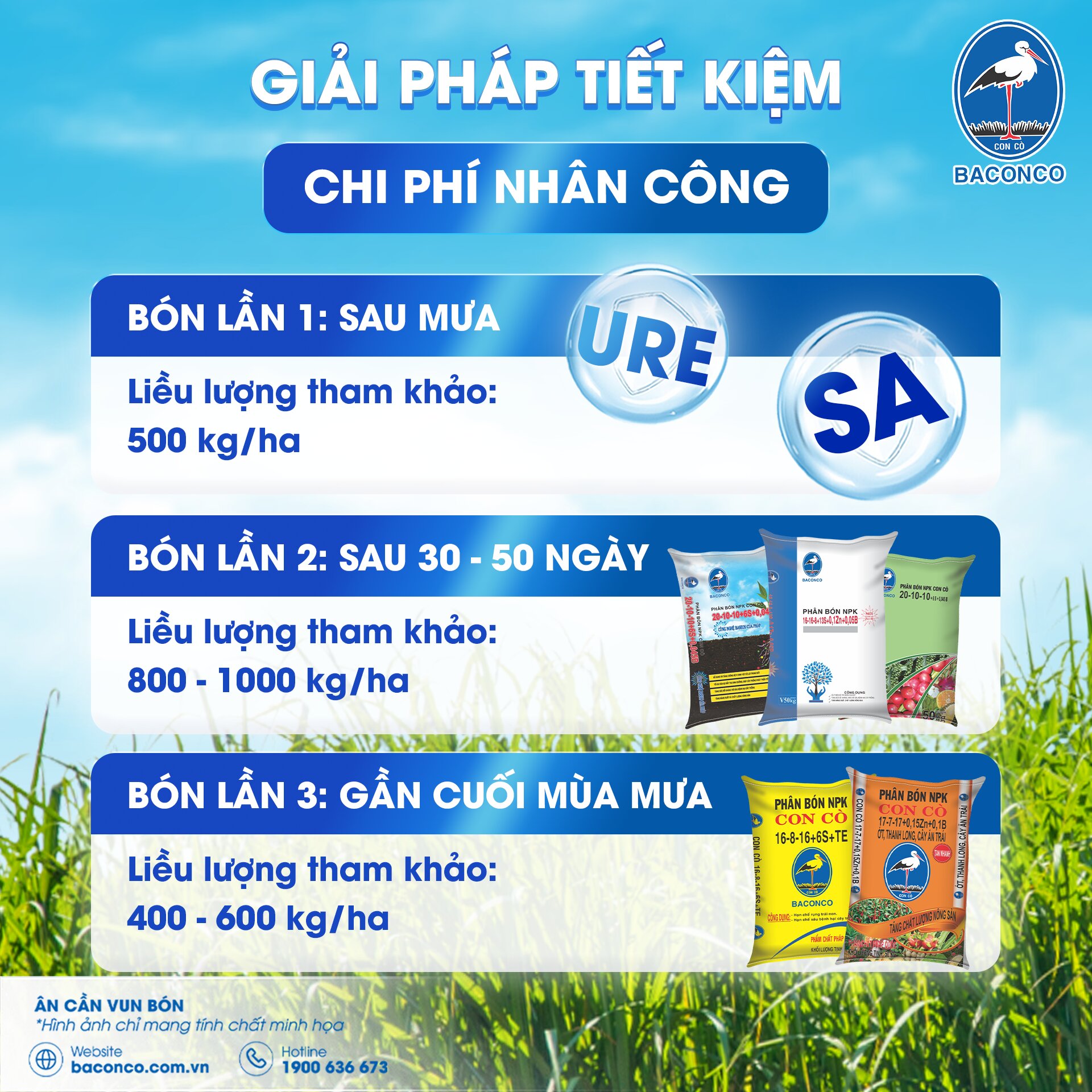
Under labor shortage conditions, many growers reduce fertilizer applications to three times per crop.
To maintain the effectiveness of fertilization techniques for ratoon sugarcane, the following schedule may be considered:
Application 1 (after rainfall)
- Urea or SA
- 500 kg/ha
Application 2 (30–50 days)
- NPK CON CO 20-10-10+6S+0.045B
- NPK CON CO BASEOS 20-10-10+6S+0.045B
- NPK CON CO 16-16-8+13S+0.1Zn
Recommended rate:
800–1,000 kg/ha
Application 3 (toward the end of the rainy season)
- NPK CON CO 16-8-16+6S+TE
- NPK CON CO 17-7-17+0.15Zn+0.1B
Recommended rate:
400–600 kg/ha
This approach ensures that sugarcane receives adequate nutrition during the most critical growth stages while reducing labor costs and simplifying field operations.
Fertilization techniques for ratoon sugarcane contribute to higher yield and better crop quality
Applying fertilization techniques for ratoon sugarcane throughout each growth stage helps provide balanced nutrition for healthy crop development.
Combining appropriate NPK CON CO fertilizers with effective ratoon sugarcane management can help:
- Promote vigorous shoot emergence.
- Develop thicker stalks and longer internodes.
- Maintain healthy green foliage.
- Improve sugar accumulation.
- Reduce lodging during the rainy season.
In addition, growers are encouraged to monitor field conditions regularly and adjust fertilizer rates according to soil characteristics, weather conditions, and crop performance to maximize production efficiency.
Conclusion
Fertilization techniques for ratoon sugarcane play a crucial role in promoting vigorous regrowth, developing thick stalks and long internodes, and enhancing sugar accumulation throughout the production cycle.
Selecting suitable NPK CON CO fertilizers, applying them at the appropriate growth stages, and maintaining proper ratoon sugarcane management help ensure stable crop development, improve sugarcane yield, and enhance sugarcane quality at harvest. These practices also provide a strong foundation for sustainable and efficient sugarcane production.


Views
3